
Introduction
For decades, barcode scanning has served as the foundation of inventory management. However, as operations scale, its limitations become increasingly clear. Manual processes, lack of real-time visibility, and rising labor costs make barcode systems difficult to sustain in modern logistics environments. RFID introduces a fundamentally different approach by enabling automated data capture, real-time tracking, and scalable operations.
Time Comparison: Barcode vs RFID Scanning
One of the most significant differences between barcode and RFID systems is the time required to perform inventory operations. In barcode-based environments, each item must be manually located, positioned, and scanned individually. This creates a highly labor-intensive process that becomes increasingly inefficient as inventory volumes grow. In addition to counting time, organizations must also account for the time spent searching for misplaced or missing items.
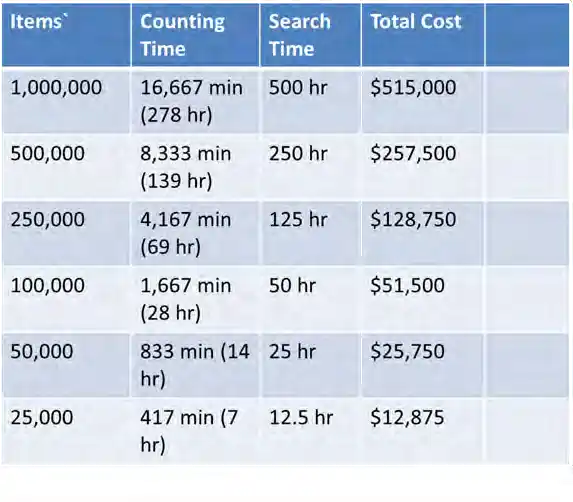
The matrix below illustrates the total time required for barcode-based inventory operations:
Manual Barcode Scanning Time Matrix
Barcode Matrix
As shown, scanning one million items requires 278 hours of counting time and an additional 500 hours of search time, resulting in a massive operational burden. Even at smaller volumes, the time commitment remains significant, making frequent inventory counts impractical.
RFID Time Efficiency: A Step Change in Performance
RFID fundamentally changes this model by eliminating the need for manual scanning. Instead of processing items one at a time, RFID systems can scan approximately 1,000 items in just a few seconds, allowing entire pallets or large groups of assets to be captured instantly. Because RFID automates data collection, both counting and search times are dramatically reduced.
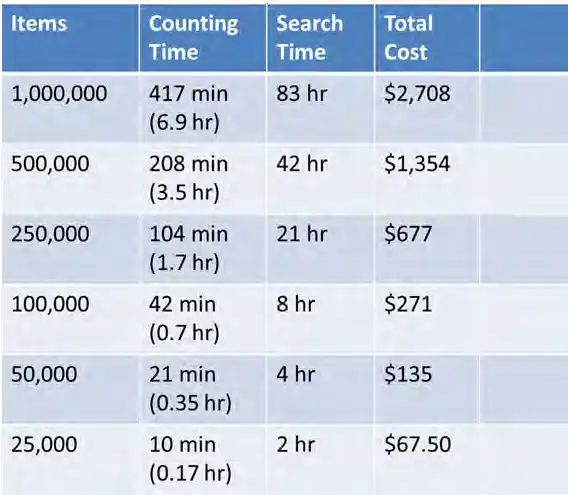
RFID Scanning Time Matrix
RFID Matrix
With RFID, counting one million items requires only 6.9 hours, compared to 278 hours using barcode scanning. Search time is also reduced from 500 hours to just 83 hours, enabling organizations to locate assets far more efficiently.
What This Means Operationally
The difference between these two approaches is not just incremental. it represents a
complete transformation in how inventory operations are performed.
With barcode scanning, inventory counts are:
- Labor-intensive
- Time-consuming
- Performed infrequently due to operational disruption With RFID, inventory operations become:
- Fast and automated
- Continuous and real-time
- Scalable without additional labor
This allows organizations to move from periodic inventory audits to ongoing, real-time
inventory visibility.
Cost Implications of Time Reduction
Time directly translates into cost. The hundreds of labor hours required for barcode scanning result in significant annual expenses. As shown in your earlier analysis, barcodebased inventory operations can exceed $500,000 annually for large-scale environments. RFID eliminates most of this labor requirement. By reducing counting time from hundreds of hours to just a few hours, and search time from days to hours, RFID drives over 99% cost reduction in inventory operations.
Speed and Throughput Advantage
Beyond cost savings, RFID introduces a level of speed that barcode systems simply cannot
match. Instead of relying on human interaction, RFID systems automatically capture data
as assets move through a facility.
This means:
- Entire pallets can be scanned instantly
- No need to stop or handle individual items
- High-throughput environments operate without bottlenecks
This level of performance enables organizations to complete full inventory counts in a single shift instead of days or weeks using barcode systems.
Conclusion
The comparison between barcode scanning and RFID highlights a clear and compelling advantage. Barcode systems, while familiar, are limited by manual processes and do not scale efficiently. RFID, on the other hand, introduces automation, real-time visibility, and dramatic improvements in speed and cost. By reducing both counting time and search time by orders of magnitude, RFID transforms inventory management from a reactive, labor-intensive process into a proactive, intelligent system.
Closing Statement
RFRain’s RFID platform delivers this transformation through a fully integrated ecosystem of devices, software, and cloud services. By enabling real-time visibility and eliminating manual workflows, RFRain empowers organizations to operate more efficiently, scale confidently, and make faster, data-driven decisions.