
Introduction
As organizations continue to modernize their operations, the demand for real-time inventory visibility has become a critical business requirement rather than a competitive advantage. Companies across logistics, manufacturing, healthcare, and retail are seeking systems that provide immediate insight into asset location, status, and movement. However, implementing such a system is far more complex than simply deploying RFID hardware.
A fully functional real-time inventory solution requires a tightly integrated ecosystem of devices, software, and data infrastructure. Many organizations attempt to assemble this ecosystem using multiple vendors, often resulting in fragmented systems, integration challenges, and increased costs. This is where an Original Equipment Manufacturer (OEM) that delivers a complete, end-to- end RFID solution provides a significant advantage.
The Business Need: What Customers Actually Require
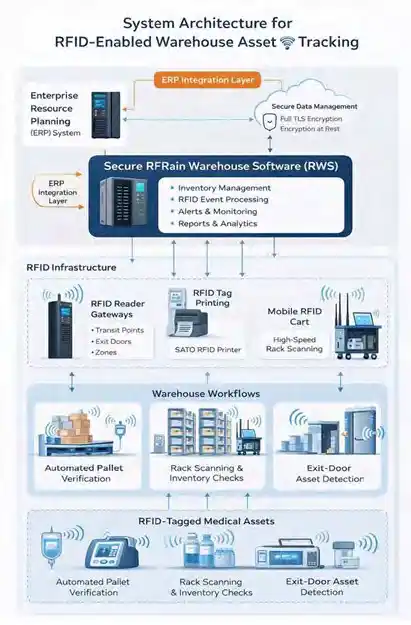
When a customer sets out to deploy a real-time inventory tracking system, the requirements extend well beyond simply reading RFID tags. The business need is comprehensive and spans multiple layers of infrastructure. At the physical level, organizations require fixed RFID readers positioned at key transition points such as warehouse doors, dock doors, and transit areas. These readers are responsible for automatically detecting assets as they move in and out of controlled zones, ensuring that all movement is captured without manual intervention.
In addition to fixed infrastructure, customers also require mobility. Handheld RFID readers play a critical role in enabling spot counts, cycle counts, and inventory verification at the shelf or pallet level. These devices allow operators to quickly scan items in place, providingflexibility that complements fixed reader deployments. Beyond data capture, customers must also manage the creation of RFID labels. This often involves printing tags on various materials, including standard paper labels and specialized metal-compatible tags. A reliable system must therefore include the ability to generate and print RFID labels both locally and remotely.
Once data is captured, the challenge shifts to data management. Customers need a robust mechanism to collect data from all devices, filter it intelligently, and store it in a centralized and reliable repository. This data must not only be stored but also structured in a way that allows for easy retrieval and analysis. Equally important is the ability to extract meaningful insights from this data. Organizations require visibility into key attributes such as asset location, asset type, and the exact time of detection. Without this level of insight, raw data provides little operational value.
Finally, the system must integrate seamlessly with enterprise platforms such as Warehouse Management Systems (WMS) and Enterprise Resource Planning (ERP) systems.
Data must be transmitted in near real time to enable immediate action, whether that involves locating an item, verifying inventory levels, or determining operational readiness.
In many cases, customers also require event-driven capabilities. This includes the ability to generate alerts when predefined conditions are met, such as detecting an asset in the wrong location, identifying process deviations, or monitoring conditions like expiration dates. Taken together, these requirements define the true scope of a modern IoT-enabled inventory system. It is not a single product, but rather a coordinated ecosystem.
The Challenge with Multi-Vendor Solutions
Many organizations attempt to fulfill these requirements by sourcing components from multiple vendors. While this approach may seem flexible, it often introduces significant complexity. Hardware, software, and cloud systems must be integrated manually, leading to long deployment cycles and increased risk of failure. Data formats may not align, communication protocols may differ, and system performance can become inconsistent. In addition, troubleshooting becomes more difficult when responsibility is distributed across multiple providers. Ultimately, this fragmented approach can delay time-to-value and increase the total cost of ownership.
The RFRain Advantage: A True End-to-End OEM Solution
RFRain addresses these challenges by delivering a fully integrated RFID solution as a single OEM provider. By designing and developing the entire ecosystem—including hardware, software, gateway, and cloud infrastructure—RFRain ensures that all components work together seamlessly. At the edge, RFRain’s fixed readers are deployed at doorways and transition points to automatically monitor assets as they move throughout a facility. These readers provide continuous visibility into asset movement without requiring manual interaction.
For mobile operations, RFRain handheld devices equipped with the RFRain Mobile application enable efficient spot counts and inventory verification. These devices extend RFID capabilities beyond fixed infrastructure, allowing operators to interact directly with inventory in real time. A key differentiator is the Real-Time Engine embedded within RFRain devices. This capability allows handhelds and readers to perform immediate validation during scanning processes. For example, during a spot count, the system can instantly identify missing items and provide feedback to the operator without requiring backend processing.
The RFRain gateway layer simplifies device management and extends system functionality. It provides a unified interface for tasks such as RFID label printing, enabling users to generate tags locally or remotely with ease. This eliminates the need for separate, disconnected printing systems. At the software layer, RFRain’s Zone Manager platform enables real-time data transmission from devices to the cloud or enterprise network. Data is processed and transmitted efficiently, with latency typically under eight seconds, ensuring that information remains timely and actionable.
At the core of the system is RFRain Web Services (RWS), which serves as the centralized data platform. RWS can be deployed in the cloud or on-premise, providing flexibility based on customer requirements. It stores all asset data, maintains historical records, and enables real-time integration with enterprise systems such as Microsoft Dynamics 365 and SAP.
RWS also supports advanced functionality such as event-driven alerts. Customers can define custom rules to trigger notifications when specific conditions occur, such as detecting an asset in an unauthorized location or identifying products approaching expiration. This transforms the system from a passive tracking solution into an active
operational intelligence platform.
From Data Collection to Actionable Intelligence
The true value of an integrated RFID system lies not just in data collection, but in the ability to convert that data into actionable intelligence. By combining edge processing, centralized data management, and real-time integration, RFRain enables organizations to act on information immediately. Whether locating an asset, verifying inventory levels, or responding to an operational exception, decisions can be made quickly and confidently.
This level of responsiveness is essential in modern environments where delays can result in lost revenue, operational inefficiencies, or compliance risks.
Conclusion
Implementing a real-time inventory tracking system is a complex undertaking that requires coordination across multiple layers of technology. Organizations that rely on fragmented, multi-vendor solutions often face integration challenges, higher costs, and delayed results.
RFRain’s OEM approach eliminates these challenges by providing a complete, end-to-end solution that integrates hardware, software, gateway, and cloud infrastructure into a single cohesive platform.
By delivering a unified system that captures, processes, and distributes data in real time, RFRain enables organizations to achieve true operational visibility, improve efficiency, and scale with confidence.
Closing Statement
RFRain’s fully integrated RFID platform is designed to meet the real-world demands of modern inventory management. By combining advanced hardware, intelligent software, and a powerful cloud infrastructure, RFRain delivers a seamless solution that transforms data into immediate, actionable insight—empowering organizations to operate smarter, faster, and more efficiently.