
Introduction
Installing a fixed RFID reader at a doorway—commonly referred to as an RFID portal—is one of the most effective methods for enabling real-time asset tracking in modern logistics and warehouse environments. As supply chains become more complex and demand for visibility increases, organizations are turning to RFID technology to eliminate manual processes and improve operational efficiency. However, achieving consistent and reliable RFID read performance, particularly in high- throughput environments, is not simply a matter of installing hardware. It requires a thoughtful approach to antenna placement, reader configuration, tag selection, and environmental considerations. When properly implemented, an RFID doorway can deliver near-perfect read accuracy and enable real-time verification of palletized inventory. This guide provides a comprehensive overview of how to deploy a fixed RFID reader on a 30×20-foot doorway, with a focus on maximizing read rates and ensuring long-term system performance.
Understanding the RFID Doorway Architecture
An RFID doorway, or portal, is typically installed at key transition points such as dock doors, warehouse entryways, or staging zones. The purpose of this setup is to automatically capture RFID-tagged assets as they move through the portal without requiring manual scanning. For a doorway measuring 30 feet by 20 feet, the optimal configuration utilizes a four-port UHF RFID reader. This type of reader supports multiple antennas, allowing the system to create a controlled and highly effective RF read zone around the doorway. By distributing antennas strategically, it becomes possible to capture tags from multiple angles, which is critical when dealing with palletized goods where tag orientation can vary significantly.
In this configuration, one antenna is placed on the left side of the doorway and one on the right side. In addition, two antennas are mounted above the doorway to provide overhead coverage. Together, these antennas form a multi-directional RF field that significantly improves the probability of reading every tag on a pallet as it passes through the portal.
Optimizing Antenna Placement for Full Coverage
Antenna placement is one of the most important factors in achieving high read accuracy. While it may be tempting to mount antennas at convenient or visually appealing locations, improper positioning can result in missed reads and inconsistent performance. The side antennas should be mounted lower on the doorway rather than at mid-height or above. This lower positioning is critical because it allows RF energy to reach the bottom layers of a pallet. In many real-world deployments, antennas that are mounted too high fail to adequately illuminate the lower portion of the load, leading to missed tags and incomplete reads. By lowering the side antennas, the RF field is directed into the base and middle sections of the pallet, ensuring that all layers are covered.
The top-mounted antennas serve a complementary role by projecting RF energy downward. These antennas are responsible for capturing tags located on the upper layers of the pallet as well as assisting with penetration into densely packed configurations. When combined with the lower side antennas, the result is a three-dimensional coverage pattern that includes the left, right, and top of the pallet. This multi-angle approach is essential for overcoming challenges related to tag orientation, packaging density, and pallet stacking. It ensures that even tags located in the interior of the load have a high probability of being read.
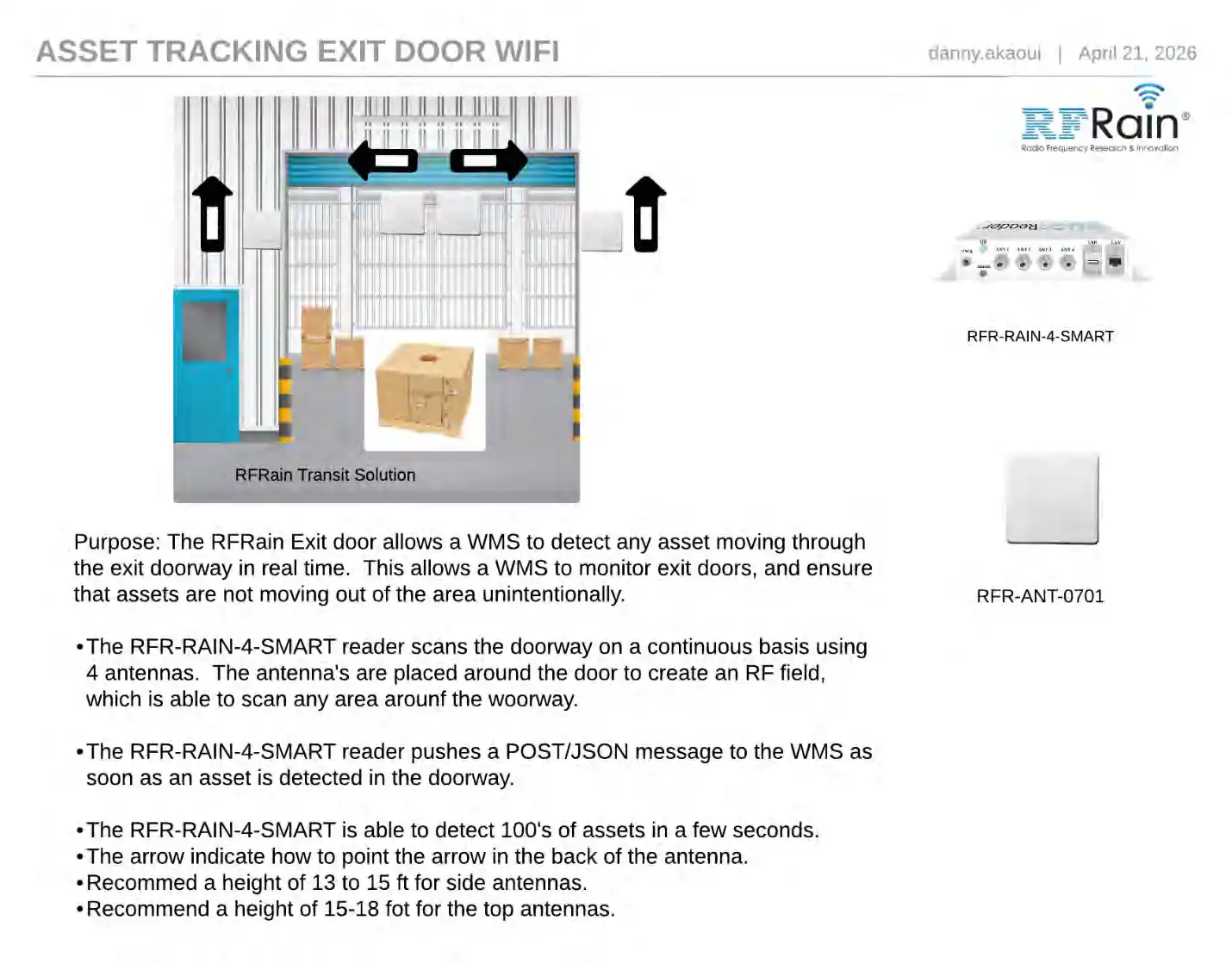
Fig 1
Achieving High Read Accuracy for Palletized Inventory
For standard pallet configurations, such as a five-by-four layout, achieving near 100 percent read accuracy depends heavily on both the physical environment and the characteristics of the materials being tracked. RFID operates using radio frequency signals, and these signals can be affected by the contents of the pallet.
Materials such as metal and liquids present significant challenges. Metal surfaces tend to reflect RF signals, while liquids absorb RF energy. Both of these effects can prevent the signal from reaching tags located in the center of the pallet. As a result, environments with high concentrations of these materials may experience reduced read performance unless additional measures are taken. In contrast, RF-friendly materials such as dry goods, textiles, and standard packaged items allow signals to pass more freely, making it easier to achieve consistent reads across all layers of the pallet. Understanding the composition of the inventory being tracked is therefore essential when designing an RFID system.
The Importance of Proper RFID Tag Selection
While reader configuration and antenna placement are critical, the performance of the system ultimately depends on the quality and suitability of the RFID tags themselves. Selecting the correct tag for the application ensures that the system can achieve the desired read range and reliability. For corrugated boxes and general-purpose applications, tags should provide a minimum read range of approximately 30 feet. High-performance inlays, such as the Impinj M series, are commonly recommended due to their sensitivity and ability to perform consistently in dense environments. These tags are well-suited for palletized goods and offer reliable performance across a wide range of use cases.
When dealing with metal assets, standard RFID tags are not sufficient. Metal surfaces interfere with the antenna structure of traditional tags, causing signal degradation. In these cases, specialized on-metal RFID tags must be used. These tags are designed specifically to operate in proximity to metal and are engineered to maintain performance where standard tags would fail. As with corrugated applications, a read range of approximately 30 feet should be targeted to ensure consistent detection.
RFRain Smart Reader Configuration Best Practices
Once the physical installation is complete, proper reader configuration is essential to achieving optimal performance. The RFRain Smart Reader platform provides several capabilities that simplify deployment while enhancing reliability. The recommended transmit power for this application is 30 dBm. This power level ensures that sufficient RF energy is available to penetrate pallet layers and reach tags located deep within the load, while avoiding unnecessary interference.
The reader should be operated in Server Mode, which enables centralized management and real-time communication with backend systems. This mode ensures consistent performance across deployments and enables seamless integration with enterprise applications.
Real-Time Pallet Verification and Exception Detection
One of the most valuable capabilities of an RFID doorway is the ability to perform real-time verification of pallet contents. This capability is enabled through tight integration between the Real-Time Engine running on the reader and RFRain Web Services (RWS), which can operate either in the cloud or within the enterprise network. The process is designed to be both efficient and responsive. RFRain Web Services receives the list of expected tag IDs for a given pallet from the client system. This data is then made available to the RFID reader, which retrieves the expected tag set and performs the comparison locally using the Real-Time Engine. By executing this logic directly at the edge, the system can instantly compare observed tag reads against expected inventory data as the pallet passes through the doorway.
This architecture allows organizations to detect missing or misplaced items immediately, rather than discovering discrepancies hours or days later. Operators receive real-time feedback and can take corrective action on the spot. In addition, the system can automatically trigger alerts when inconsistencies are detected, reducing the risk of downstream errors and improving operational responsiveness. This shift from passive tracking to active, edge-based verification represents a significant advancement in warehouse operations. By combining real-time processing at the reader with centralized data management through RFRain Web Services, organizations achieve higher accuracy, faster decision-making, and greater overall efficiency and accountability.
Operational Benefits of a Properly Configured RFID Doorway
When all components of the system are properly implemented, an RFID doorway delivers substantial operational benefits. Organizations can achieve near-perfect read accuracy, significantly reduce reliance on manual scanning, and accelerate the movement of goods through dock doors. Real-time visibility into inventory enables better decision-making and helps prevent costly errors. The ability to detect exceptions immediately improves quality control and reduces the need for manual reconciliation. Over time, these improvements translate into measurable cost savings and increased operational resilience.
Conclusion
Installing a fixed RFID reader on a 30×20 doorway requires a comprehensive understanding of RF behavior, proper antenna placement, careful tag selection, and optimized system configuration. By positioning antennas strategically, selecting the appropriate tags, and leveraging the capabilities of the RFRain Smart Reader platform, organizations can achieve highly reliable performance even in complex environments. The result is a system that transforms doorway operations from manual and error-prone processes into automated, real-time intelligence points that drive efficiency and accuracy across the supply chain.
Closing Statement
RFRain’s edge-enabled Smart Reader platform simplifies RFID deployments while delivering real-time visibility and control at the point of data capture. By combining intelligent hardware with advanced software capabilities, RFRain enables organizations to deploy scalable, high-performance RFID solutions with minimal complexity.